There is more good news :)
It appears that we made an invention (when this is defined by something which
get's patented). Currently we construct an experimental prototype (which is real
hardware). It takes a lot of time but it is also exiting and makes a lot of fun. The details evolve along construction in discussion with the (excellent) mechanic of my
engineering chair. Next week we will start meassurements - and if all works fine
we'll try to apply for a patent.
I learned some mechanical basics before I started my first study (engineering) and
it remindes me to that times.
What is really cool, if the stuff works - it's found by optimization. Engineers are
working for quite some time to solve the problem - maybe the algorithm found it (it's not that intuitive in the first glance) ... well, let's see.
Friday, 20 February 2009

Paper accepted
Lucky day today :)
Some time ago I got back the review of our first paper. I'm currently working on the next version, taking the comments of the reviewer into account.
What I did not post, is that we also submitted a second paper dealing with the dynamic optimization. It was submitted along the OIPE workshop. Here is the preprint. The comments of the two reviewers came today and were actually quite good (twice an "eight"). I was escpecially happy about the comment "The detailed discussion is nice." as a lot of effert went into that paper.
After working in the comments the paper will appear in a special issue (optimization and inverse problems) of the International Journal of Applied Electromagnetics and Mechanics IJAEM.
What is the paper about? It does dynamic optimization of the piezoelectric loudspeaker:

Brown is the thin metal plate (think of the "membrane" of a loudspeaker, even if the term is in this case not correct) which is excited by a thin piezoelectric layer (blue). We search for the best topology of the piezoelectric layer.
What needs to be clearified in the first paper, is that we need no volume constraint. Hence, when doing a parameter study optimizing for many frequencies from 20 to 2000 Hz

We can check what the optimal volume is and if it is really "black and white" enough. This is the special intrinsic piezoelectric feature we found and what needs to expressed in more detail for the revision of the first paper.

A typical example (800 Hz) is the following picture where blue means "no piezoelectric material" but brown means, "yes - place the pizeo here".

The paper discusses some interesting ressonance issues of piezoelectric optimization (it's special there!) and does also multiple frequency optimization. But that's much to much for a blog posting.
Some time ago I got back the review of our first paper. I'm currently working on the next version, taking the comments of the reviewer into account.
What I did not post, is that we also submitted a second paper dealing with the dynamic optimization. It was submitted along the OIPE workshop. Here is the preprint. The comments of the two reviewers came today and were actually quite good (twice an "eight"). I was escpecially happy about the comment "The detailed discussion is nice." as a lot of effert went into that paper.
After working in the comments the paper will appear in a special issue (optimization and inverse problems) of the International Journal of Applied Electromagnetics and Mechanics IJAEM.
What is the paper about? It does dynamic optimization of the piezoelectric loudspeaker:
Brown is the thin metal plate (think of the "membrane" of a loudspeaker, even if the term is in this case not correct) which is excited by a thin piezoelectric layer (blue). We search for the best topology of the piezoelectric layer.
What needs to be clearified in the first paper, is that we need no volume constraint. Hence, when doing a parameter study optimizing for many frequencies from 20 to 2000 Hz
We can check what the optimal volume is and if it is really "black and white" enough. This is the special intrinsic piezoelectric feature we found and what needs to expressed in more detail for the revision of the first paper.
A typical example (800 Hz) is the following picture where blue means "no piezoelectric material" but brown means, "yes - place the pizeo here".
The paper discusses some interesting ressonance issues of piezoelectric optimization (it's special there!) and does also multiple frequency optimization. But that's much to much for a blog posting.
Friday, 16 January 2009
Books about Topology Optimization
When it comes about the SIMP method, the standard book is clearly
Bendsoe, M.P. and Sigmund, O.; Topology Optimization: Theory, Methods, and Applications; Springer; 2003 (scholar.google, amazon). Bendsoe and Sigmund are the godfathers of modern SIMP and their review book like work gives a lot of insight into various achievements and limits of the method. On the other side it is not that appropriate to hand to a studendt to get a glimpse about SIMP, especially on the basics and backgrounds.
Since a couple of weeks only there is another book available:
Christensen, P.W. and Klarbring, A.; An Introduction to Structural Optimization; Springer; 2008 (scholar.google, amazon). It covers truss optimization, SIMP but also the necessary basics in optimization mathematics (e.g. convexity, MMA, ...). I would say it is ideal for studens of computational engineering. For math students the proofs are missing but "normal" engineers should not fear math language, albeit the content is appropiate for them. The book has even exercies and gives a very good introduction to the subject.
Concerning the covered content: Background and exercises versus review like collection of applications, do these books complement each other almost ideally. One (engineer) should just read Christensen and Klarbring prior to Bendsoe and Sigmund (after browsing the later's applications as motivation :)).
Bendsoe, M.P. and Sigmund, O.; Topology Optimization: Theory, Methods, and Applications; Springer; 2003 (scholar.google, amazon). Bendsoe and Sigmund are the godfathers of modern SIMP and their review book like work gives a lot of insight into various achievements and limits of the method. On the other side it is not that appropriate to hand to a studendt to get a glimpse about SIMP, especially on the basics and backgrounds.
Since a couple of weeks only there is another book available:
Christensen, P.W. and Klarbring, A.; An Introduction to Structural Optimization; Springer; 2008 (scholar.google, amazon). It covers truss optimization, SIMP but also the necessary basics in optimization mathematics (e.g. convexity, MMA, ...). I would say it is ideal for studens of computational engineering. For math students the proofs are missing but "normal" engineers should not fear math language, albeit the content is appropiate for them. The book has even exercies and gives a very good introduction to the subject.
Concerning the covered content: Background and exercises versus review like collection of applications, do these books complement each other almost ideally. One (engineer) should just read Christensen and Klarbring prior to Bendsoe and Sigmund (after browsing the later's applications as motivation :)).
Thursday, 25 December 2008
Serguei Nazarov - The Big Fish
Prof. Nazarov was invited to Erlangen 2 weeks before. Within my project topology optimization is also done via topology gradients, mathematical hard core where pure mathematicians meet the applied ones. I'm an engineer, I do SIMP and it is hard for me to understand what the mathematicians do (I want to start another try for a functinal analysis book the next weeks).
Anyway I was asked to give a short talk and present the piezoelectric-mechanical-acoustic coupled PDE from an practical engineering point of view (application, meshing, boundary conditions, ...). The talk was to be given for Prof. Nazarov, I never heard of. So I googled and it was interesting what I found.
First the image from his website in Russia
He is an expert on asymtotical extensios. On His page are links to his 13 books!! and 366 papers!! There is really nothing to add beside that he is a nice and funny guy. :)
Anyway I was asked to give a short talk and present the piezoelectric-mechanical-acoustic coupled PDE from an practical engineering point of view (application, meshing, boundary conditions, ...). The talk was to be given for Prof. Nazarov, I never heard of. So I googled and it was interesting what I found.
First the image from his website in Russia
He is an expert on asymtotical extensios. On His page are links to his 13 books!! and 366 papers!! There is really nothing to add beside that he is a nice and funny guy. :)
Wednesday, 17 December 2008
SIMP Introduction
From time to time I give a introductory talk about the SIMP method. I only cover linear elasticity as the results can be more easy understand as my piezoelectricity stuff. This is an update of the older version.
This time we made a movie of my talk (45 minutes).
Here are the slides (1.3 MB)
Here is the divx movie (460 MB !!)
This is the second time I record a talk of mine. The first time I used the internal mic of the cam and as such one could not hear me but the audience. This time I used a wireless mic. We did not adjust the sound but for a first try ... on can at least understand me. The next time we shall give more attention on zooming and light conditions.
P.S.: Do you know where I could put the video online? Youtube has a 10min limit.
This time we made a movie of my talk (45 minutes).
Here are the slides (1.3 MB)
Here is the divx movie (460 MB !!)
Topology Optimization Using the SIMP Method
View SlideShare presentation or Upload your own.
This is the second time I record a talk of mine. The first time I used the internal mic of the cam and as such one could not hear me but the audience. This time I used a wireless mic. We did not adjust the sound but for a first try ... on can at least understand me. The next time we shall give more attention on zooming and light conditions.
P.S.: Do you know where I could put the video online? Youtube has a 10min limit.
Friday, 14 November 2008
The 'smartest' people in the world
One thing that is cool about doing a PhD (there are also uncool things - I just dont't have the money for the next (used) car, the current one is badly old :( ) is getting into contact to professors and such guys.
Albeit comming from a familiy where education has been well treasured, I am the first with a university degree. I remember when I was about 15 when I met the first students as my boy scout leaders. One of them, a guy doing his PhD in optics, explained me what a 'professor' is. His definition was "no one on earth knows more about a subject than him". Impressing! ... and it never matched reality when I did my diploma at an 'Fachhochschule' (university of applied science) - albeit I learned much!
Once my later PhD adviser told me "that you never know what a chair is when U don't do a PhD at a chair". I replayed "well I learn when doing my diploma thesis" and he replayed "no, you don't". He was right.
I believe, that a typical PhD (like me!) is just a normal person. Just as almost any other graduate student - having become a PhD student (more or less) just by random. But one truly meets some other guys, extraordinary intelligent people - what holds for probably most professors ...
I wouldn't want to miss coming into contact to such people and I'm happy to have such an opportunity. But the really interesting this is (and therefore I put that 'smart' in the headline into quotation marks) that these people are definetely highly
intelligent but beside that just normal people - having similar troubles and luck as all 'normal' people have.
Albeit comming from a familiy where education has been well treasured, I am the first with a university degree. I remember when I was about 15 when I met the first students as my boy scout leaders. One of them, a guy doing his PhD in optics, explained me what a 'professor' is. His definition was "no one on earth knows more about a subject than him". Impressing! ... and it never matched reality when I did my diploma at an 'Fachhochschule' (university of applied science) - albeit I learned much!
Once my later PhD adviser told me "that you never know what a chair is when U don't do a PhD at a chair". I replayed "well I learn when doing my diploma thesis" and he replayed "no, you don't". He was right.
I believe, that a typical PhD (like me!) is just a normal person. Just as almost any other graduate student - having become a PhD student (more or less) just by random. But one truly meets some other guys, extraordinary intelligent people - what holds for probably most professors ...
I wouldn't want to miss coming into contact to such people and I'm happy to have such an opportunity. But the really interesting this is (and therefore I put that 'smart' in the headline into quotation marks) that these people are definetely highly
intelligent but beside that just normal people - having similar troubles and luck as all 'normal' people have.
Sunday, 26 October 2008
Conference Season is over
Whew! That really was a tough time!
After preparing and giving three talks I had quite some pressure to produce results for the upcomming conference season. So no relaxing semester break but using this time where most students, bosses and colleagues are on holiday for concentrated working.
The good thing (in retrospect) was that I again had to write a paper. The first event was the OIPE, the 10th Workshop on Optimization and Inverse Problems in Electromagnetism from 14. to 17. September 2008 in Ilmenau. My submitted two page digest was my first peer reviewed work and it is published in the proceedings. I gave a poster presentation and it was a interesting event - that brought me also further in my subject. It's always good to see that also the others cook only with water:) The OIPE offered the possibility to submit a paper for review and publication in a journal. This gave the pressure but on the other hand was writing down the stuff essential to understand what my results actually mean (again).
The next step was the annual meeting of the research program where my project is a part of. We met in Kloster Banz, a huge former monastry known where politicians meet in conclave. It's one of the places I would not have visited otherwise and it was pretty cool to stroll around this place at night. A highlight was the guitar performance of two mathematicians with funny and ironic lyrics about beeing a mathematician. :)
And after that there was the Fourth International Workshop Direct and Inverse Problems in Piezoelectricity in a impressive castle (Pommersfelden). Here is the talk.

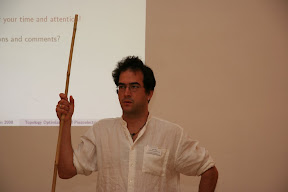
With the first PhD year beeing a starting year, scientific workshops where too early. Now I feel like becomming part of the "community" (also I still have no active contact to other groups doing SIMP optimization). With the good time one has at these conferences it's kind of sad that suddenly it's towards the end of the PhD time.
I have really cool results (with pretty cool 3D images with colors, transparency and all this stuff). I shall blog about this soon.
After preparing and giving three talks I had quite some pressure to produce results for the upcomming conference season. So no relaxing semester break but using this time where most students, bosses and colleagues are on holiday for concentrated working.
The good thing (in retrospect) was that I again had to write a paper. The first event was the OIPE, the 10th Workshop on Optimization and Inverse Problems in Electromagnetism from 14. to 17. September 2008 in Ilmenau. My submitted two page digest was my first peer reviewed work and it is published in the proceedings. I gave a poster presentation and it was a interesting event - that brought me also further in my subject. It's always good to see that also the others cook only with water:) The OIPE offered the possibility to submit a paper for review and publication in a journal. This gave the pressure but on the other hand was writing down the stuff essential to understand what my results actually mean (again).
The next step was the annual meeting of the research program where my project is a part of. We met in Kloster Banz, a huge former monastry known where politicians meet in conclave. It's one of the places I would not have visited otherwise and it was pretty cool to stroll around this place at night. A highlight was the guitar performance of two mathematicians with funny and ironic lyrics about beeing a mathematician. :)
And after that there was the Fourth International Workshop Direct and Inverse Problems in Piezoelectricity in a impressive castle (Pommersfelden). Here is the talk.

With the first PhD year beeing a starting year, scientific workshops where too early. Now I feel like becomming part of the "community" (also I still have no active contact to other groups doing SIMP optimization). With the good time one has at these conferences it's kind of sad that suddenly it's towards the end of the PhD time.
I have really cool results (with pretty cool 3D images with colors, transparency and all this stuff). I shall blog about this soon.
Subscribe to:
Comments (Atom)