I consider to publish more C++ code like C++SCPIP. I hope for
a C++ILUPACK version, maybe a C++MMA and then there is a FEM code in C++ I wrote 2 years ago together with Michael Tesch, which could serve educational purpose (C++FEM).
Therefore I renamed the Sourforge project to C++Math. As a matter of fact most academic state of the art code is written in Fortran, runs
excellent but often lacks ease of use. On the other side is this my contribution to bring more object oriented techniques into the academic community.
The next post will have some pictures again! :)
Wednesday, 19 September 2007

Thursday, 16 August 2007
Battle of the tools
As I worked for 5 years as a software developer after my
diploma degree before I did my master in computational engineering, I got used to work with tools. I shall add that I do a lot of object oriented stuff - always in the seek of a balance between framework generalization and pragmatism.
What I miss is Together, one of the best (an for non-academic used most expensive) UML tools for visual supported designing,
refactoring or simply navigation within the code. I was not able yet to make it parse the huge C++ finite element simulation code from my institute.
What I really find a big boost ist Eclipse with the C/C++ plugin. It is state of the arte and has a lot of features lightyears away from emacs and vi. For users I suggest the blog of Doug, the CDT project lead. Contact me first if you want to try it with Linux on a 64bit system (Code2, Opteron, ...)!
It integraties smooth with our version control sytem subversion. And if you ever worked with one you will never want to miss it. It is open source, fast to set-up and supported my many tools on all platforms.
For finding memory leaks we use valgrind, with the profiling tool chachegrind (which simulates the cache!). To be used with valkyrie (very important!) and kcachegrind.
For bugtracking, wiki and web-browsing our repository we use trac, a feature rich web-tool.
So it is at least my personal experience, that object oriented software and tools is good for this kind of academic, high-performance oriented software done at the universities. I simply don't belive, that FORTRAN is significantly faster. Hey, FORTRAN77 is 3 years younger than the Intel 4004! But it is on the other side true, that the learning curve for OO takes years, but this is also true for math actually for every profession.
diploma degree before I did my master in computational engineering, I got used to work with tools. I shall add that I do a lot of object oriented stuff - always in the seek of a balance between framework generalization and pragmatism.
What I miss is Together, one of the best (an for non-academic used most expensive) UML tools for visual supported designing,
refactoring or simply navigation within the code. I was not able yet to make it parse the huge C++ finite element simulation code from my institute.
What I really find a big boost ist Eclipse with the C/C++ plugin. It is state of the arte and has a lot of features lightyears away from emacs and vi. For users I suggest the blog of Doug, the CDT project lead. Contact me first if you want to try it with Linux on a 64bit system (Code2, Opteron, ...)!
It integraties smooth with our version control sytem subversion. And if you ever worked with one you will never want to miss it. It is open source, fast to set-up and supported my many tools on all platforms.
For finding memory leaks we use valgrind, with the profiling tool chachegrind (which simulates the cache!). To be used with valkyrie (very important!) and kcachegrind.
For bugtracking, wiki and web-browsing our repository we use trac, a feature rich web-tool.
So it is at least my personal experience, that object oriented software and tools is good for this kind of academic, high-performance oriented software done at the universities. I simply don't belive, that FORTRAN is significantly faster. Hey, FORTRAN77 is 3 years younger than the Intel 4004! But it is on the other side true, that the learning curve for OO takes years, but this is also true for math actually for every profession.
Friday, 10 August 2007
C++SCPIP published
I finally managed to publish my open source C++ interface to the SQP/MMA optimizer SCPIP from Chrisitan Zillober. The current entry point is cppmath.wiki.sourceforge.net.
I want to thank Christian Zillober for providing me the code of SCPIP for my thesis and Andreas Wächter from whom I took a lot of ideas and code from his IPOPT.
I hope C++SCPIP is for use of some optimizers out there. If so, please let me know :)
I want to thank Christian Zillober for providing me the code of SCPIP for my thesis and Andreas Wächter from whom I took a lot of ideas and code from his IPOPT.
I hope C++SCPIP is for use of some optimizers out there. If so, please let me know :)
Thursday, 12 July 2007
DCAMM Advanced school
I participated at the DCAMM Advanced school from June 20 - 26, 2007. This was offered by the DTU in Denmark.
This international course for Ph.D. students provided a good introduction to the SIMP
method with exercises based on the 99 lines code. DTU is full of SIMP experts (to start
with Martin Bendsoe and Ole Sigmund - who are really nice!!)
It was really inspiring and it helped me a lot to talk to the people there. Especially
Jakob Søndergaard Jensen :)
I had a good time there, met nice people and I enjoyed it to talk to so many people working
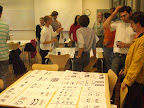
on similar problems as I do. There is an picture of the final presentation of the group results.
So, if you have an option then I advice you to attend this course the next time. One learns a lot!
This international course for Ph.D. students provided a good introduction to the SIMP
method with exercises based on the 99 lines code. DTU is full of SIMP experts (to start
with Martin Bendsoe and Ole Sigmund - who are really nice!!)
It was really inspiring and it helped me a lot to talk to the people there. Especially
Jakob Søndergaard Jensen :)
I had a good time there, met nice people and I enjoyed it to talk to so many people working
on similar problems as I do. There is an picture of the final presentation of the group results.
So, if you have an option then I advice you to attend this course the next time. One learns a lot!
Thursday, 15 March 2007
Maximizing the compliance
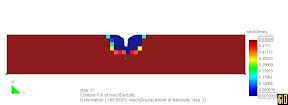
I was wondering what would happen if I maximize the compliance - in other words to minimize stiffness. Note that the compliance is defined as the scalar product of force (externaly applied in the center of this bridge) and the displacement. <f, u>. When minimizing compliance I mininimize the mechanical energy which is <u, Ku> what is equivalent. Here the first formulation is more interesting, as our force is applied in the example only at a single node. The simulation is done with IPOPT as optimizer, the animation shows, that in a first attempt IPOPT weakens the material at the fix points - but removing the material at the load point allows clearly the highest displacement at this single load point.
Monday, 5 March 2007
Comparing IPOPT with the Optimality Condition
Here I compare the optimality condition against IPOPT via the bridge well known example. Now I fix (horizontal and vertical) the lower right end but let the left end move horizontal (only the vertical displacement is fxed). I think this is a nice example about the impact of boundary conditions (compare with the 2D bridge example!).
The video using IPOPT is here IPOPT video, the video using optimality condition is optimality condition video. The final image for the the IPOPT and optimality condition optimization is:


Note, that the volume constraint (0.5) is always fulfilled! The "flickering" in the IPOPT animation can be better understood having a look at the iteration plot . IPOPT quickly runs into a local minima and it takes some time to leave it. Then one can see brave tries to escape the next minima (which could be close to the global minimum) several times. Note that I do not let IPOPT quit the optimization process but rather limit the maximal number of iterations.
What I find noticable is the with the optimality condition, I really have almost no grayness (I will have to quantify this!) what actually makes sense (and is what we want). In the literature and with [1] find more grayness at the silhouette (as with IPOPT). I'm currently reimplementing the filtering of the gradient and now I also get more "aliasing". What do you get?
[Update 10.2010]
I found that this pretty old post is sometimes still read. The key point is, that sensitivity filtering has been used. It is well known that this disturbs the original gradient and general purpose optimizers have problems with that - SNOPT normally fails. IPOPT seems to be more robust here while MMA and OC are rock solid against it. So to compare IPOPT you need rigorous regularization like density filtering, slope constraints or feature size control (e.g. MOLE) to mention a relevant regularization techniques mentioned in THE BOOK.
The video using IPOPT is here IPOPT video, the video using optimality condition is optimality condition video. The final image for the the IPOPT and optimality condition optimization is:
Note, that the volume constraint (0.5) is always fulfilled! The "flickering" in the IPOPT animation can be better understood having a look at the iteration plot
. IPOPT quickly runs into a local minima and it takes some time to leave it. Then one can see brave tries to escape the next minima (which could be close to the global minimum) several times. Note that I do not let IPOPT quit the optimization process but rather limit the maximal number of iterations.What I find noticable is the with the optimality condition, I really have almost no grayness (I will have to quantify this!) what actually makes sense (and is what we want). In the literature and with [1] find more grayness at the silhouette (as with IPOPT). I'm currently reimplementing the filtering of the gradient and now I also get more "aliasing". What do you get?
[Update 10.2010]
I found that this pretty old post is sometimes still read. The key point is, that sensitivity filtering has been used. It is well known that this disturbs the original gradient and general purpose optimizers have problems with that - SNOPT normally fails. IPOPT seems to be more robust here while MMA and OC are rock solid against it. So to compare IPOPT you need rigorous regularization like density filtering, slope constraints or feature size control (e.g. MOLE) to mention a relevant regularization techniques mentioned in THE BOOK.
Thursday, 1 March 2007
Used Toolchain
Within this posting I will add more and more of the tools I use.
- As external optimizer I use IPOPT, to be replaced soon by a MMA implementation.
A. Wächter and L. T. Biegler, On the Implementation of a Primal-Dual Interior Point Filter Line Search Algorithm for Large-Scale Nonlinear Programming, Mathematical Programming 106(1), pp. 25-57, 2006
Subscribe to:
Comments (Atom)